Kate Tietje
Measles Outbreak: Is Measles REALLY So Scary?
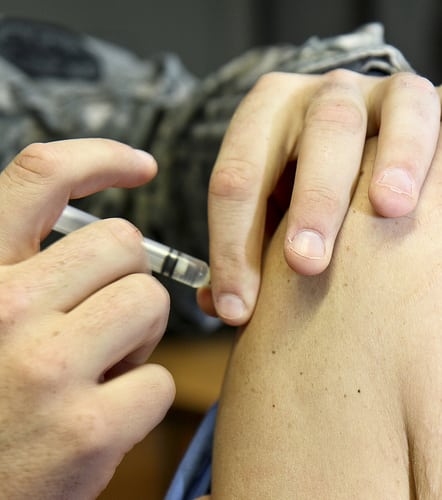
Image by USACE European
Ah, yes, here comes the fear tactics, yet again.
There’s currently an outbreak of the measles in New York City. This “outbreak” consists of just 16 cases so far. We don’t know, from the news reports, how many of these people were vaccinated and how many were not. We do know that four have been hospitalized. There have been no deaths and no instances of permanent disability reported.
Naturally, the unvaccinated are being blamed for the outbreak.
But hmm…we don’t know how many of these people actually were unvaccinated. So that means, these people could all be fully or partially vaccinated. And if that’s true…how do we blame it on the unvaccinated, exactly?
As usual, it doesn’t make any sense. People are jumping the gun, reporting things that aren’t true (or at least aren’t known for sure) and are using it to drive fear and anger towards those who don’tvaccinate. I am so very tired of this. Enough with the scare tactics and bullying!
Typical Media Pronouncements
First, you should know — I’m not here to tell that you shouldn’t vaccinate your kids. Or that you should. I actually trust you, as a parent, to make that call yourself. You don’t need me (or anyone) to bully you into making a particular decision. I trust you have a brain, that you use it, and that you know your family best.
So here are the plain facts right now:
- 16 people have the measles in New York City
- 7 adults, 9 children
- We don’t know how many were vaccinated, fully or partially
- 4 were hospitalized
- No deaths, permanent disability, or serious complications have been reported
That’s it. That’s all we know. From this information, we can’t make the leap that “unvaccinated people did it.” That’s just an easy place to go, since society hates unvaccinated people (needlessly, ridiculously).
It is true that in 2013, most of the people who got measles were unvaccinated (about 82%, according to the CDC). But it’s also true that only around 10% were hospitalized, and no incidents of permanent disability or death were recorded (in over 150 cases).
What we know, from the actual facts, is that measles is very contagious, does seem to be more common in unvaccinated people, and is not dangerous. ”Danger” being measured by “serious complications or death” — of which there were none.
But, of course, the media, specifically the rabid pro- vaccine pushers, are not interested in facts. They’re only interested in bullying. And so, with no evidence, they’ve pronounced that this is the fault of the unvaccinated. With terribly rude, negative language and no actual information, I choose to ignore them outright.
How Scary IS Measles?
What we need to know now is, just how scary is measles?
We know that measles is highly contagious, so that if you are vulnerable to it (unvaccinated, vaccinehas worn off, etc.) you are likely to get it, if you come across it. But catching it doesn’t make it scary. It’s how sick you may get, what may happen to you. What will that look like?
Measles typically has an incubation period of 14 – 21 days. It starts with 2 – 4 days of moderate to high fever (may be as high as 105), along with cough and runny nose. After this, the characteristic rash begins. The rash lasts for 5 – 6, spreading from top to bottom, then disappearing in the same order.
Complications in “some form” occur about 30% of the time. (This is all complications, not “severe” complications as some of the recent reporting claimed.) Here is what complications looked like (in a CDC report from 1985 – 1992):
- 8% had diarrhea
- 7% had ear infections
- 6% had meninigitis
- 0.1% had encephalitis (15% of people with this complication died, and about 25% had lasting neurological symptoms)
- 0.2% died
So, we see that out of 1000 cases, 80 people would have diarrhea, 70 people would have ear infections, 60 people would have meninigitis, 1 would have encephalitis, and 2 would die. The remaining 787 people would have no issues and would come through the measles just fine. Approximately 3 out of 1000 people would have “serious” complications or death.
From 2001 – 2011, there were 911 cases of measles reported. Including 2012 and 2013, that number rises to 1153 cases. If the numbers above play out, we would expect 1 case of encephalitis and 2 deaths. In fact, there were no deaths during this time period.
From that, we can assume that 1 – 2 in 1000 is possibly the highest that measles deaths will reach in a developed country, with easy access to medical care.
We also know that vitamin A status has a lot to do with measles complications. In one study, measles mortality was decreased by 62% with at least two doses of vitamin A (after the patient was admitted to the hospital with complications). In another study, death rate was reduced from 5% to 1.6%, as well as shortening hospital stay and need for intensive care.
The point is, if you get measles, you have a 99.7% chance of pulling through just fine, with no permanent disability or death. You have a 94% chance of not even needing to be hospitalized. And supposing you get severe measles, high dose vitamin A supplementation is very effective in reducing mortality and severe complications.
Removing the Fear
Yes, I know, if you’re in that 0.3% of people who do suffer serious complications or death (or your child is), there’s probably nothing anyone can say to convince you measles isn’t terrifying. Because in that case, it is! Just know that it is highly unlikely that you will be “that person.”
Honestly? There’s risk to everything. There’s risk to getting measles. There’s risk to getting the MMR. There’s risk to driving your car. Your chances of getting in a car accident are probably greater than your chances of getting seriously ill with measles.
There’s absolutely no way to remove all risk. We can’t say, “If you do x, y, and z, then you will no longer have a risk of measles, or no longer have a risk of complications.” It just isn’t the way that life works! But as I said, there is risk to the vaccine too. And the vaccine doesn’t fully remove your risk of catching measles, either.
It depends on what risk you are more comfortable taking — the vaccine, or the disease itself. But to make that decision, you should have accurate numbers and a realistic sense of what could happen, either way.
So here it is. The real numbers, the real risk. Ignore the fear tactics and decide for yourself.
What do you think — is measles really that scary? Are you tired of the bullying?
This is the writings of:

No comments:
Post a Comment